Transforming Assessment Integrity: A Fully Digital Evidence Verification and Appeals Management Framework
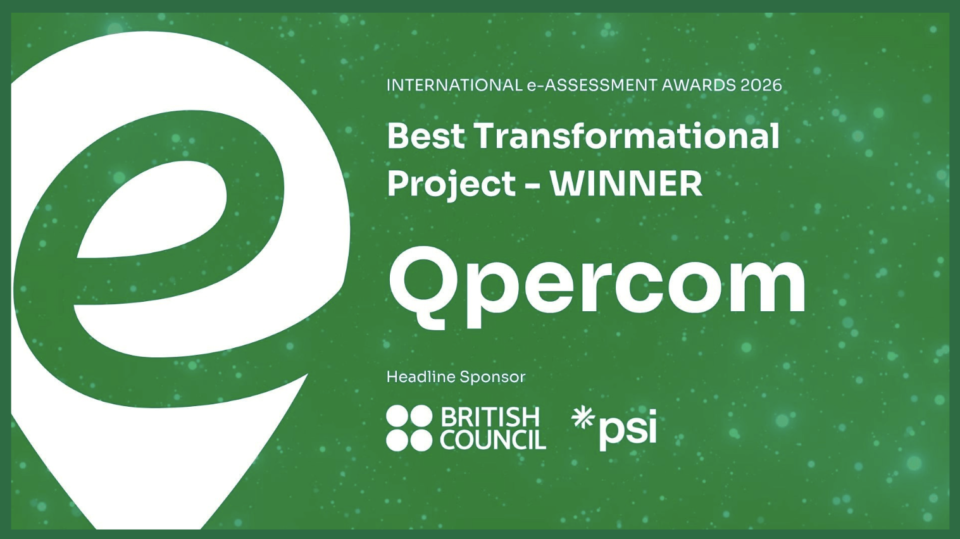
We’re delighted to share that Qpercom has won Best Transformational Project at the International eAssessment Awards 2026. We collected the award at the eAssessment Association conference in London, capping off the event on a real high for our team.
The recognition celebrates a project close to our roots: a complete redesign of how candidates submit evidence, how assessors verify it and link it to assessment decisions, and how the platform handles appeals, all within a single, secure, and transparent workflow that now runs across a national medical recruitment process.
Where It Started
Qpercom was born from clinical assessment, helping medical schools and healthcare organisations run structured, practical exams. It remains the heart of what we do. Over the years we’ve grown into interview-based selection and recruitment, and with each cycle we’ve pushed to refine and improve what’s possible. This project is the next step in that journey.
The Challenge
Assessment processes had become fragmented across multiple platforms, slow for candidates and assessors alike, and difficult to audit consistently.
In practice, candidates had to log into a separate third-party platform just to attach and submit their supporting evidence. When assessors reached the marking stage, they were forced to work across two systems at once. The core assessment platform on one screen and the external platform holding the uploaded evidence on another. That split created friction, added administrative overhead, and increased the chance of errors at exactly the points where accuracy matters most.
We understood there was a clear need for a more efficient, transparent, and fully auditable way to manage the entire process from end to end.
What We Built
Rather than bolting on another tool, we redesigned the workflow itself. The result is a centralised, browser-based system where every stage of evidence handling and appeals lives in one place:
Structured Evidence Submission
Candidates are guided to upload their documentation in a clear, consistent format, with no separate platform to navigate.
Integrated Review & Verification
Assessors and administrators review, verify, and record validation outcomes using integrated digital scoresheets, all alongside the evidence itself.
Competency Mapping
Competencies can be mapped and measured throughout the process, across assessment types and across stations within an assessment, with detailed feedback available to candidates under the full control of the administrative team.
A Clear Appeals Workflow
If a candidate disagrees with a decision, they can appeal through a defined, auditable process handled in the same system, so every case is treated consistently and transparently.
A Complete Audit Trail
Evidence, scores, assessor comments, and appeal records are linked together and stored securely, so every decision can be traced and audited when needed.
In short, a complicated, partly paper-based, multi-platform process became a single streamlined system that’s easier for candidates, assessors, and administrators.
How We Delivered It
We’ve always believed a system only works if it works for the people using it, so we involved them from day one. Assessors, administrators, and candidate representatives were engaged from the project’s inception.
We piloted iteratively through live interview rounds, with each round followed by a structured feedback phase, a thorough review, and a focused sprint of improvements. This cycle let us refine the workflows for evidence submission, review, and appeals before any wider rollout. Every user received comprehensive guidance and support to make adoption as smooth as possible.
Following a successful release to a wider group, the platform was fully rolled out across all teams and the legacy system was retired entirely. We continue to run user groups and gather feedback through formal surveys as part of an ongoing review process.
That responsiveness didn’t stop at launch. When candidate feedback pointed to friction in the upload experience, we acted quickly. In mid-January, we increased file size limits and improved the drag-and-drop process, among other refinements. The effect was measurable as candidate satisfaction rose from 3.9/5 to 4.3/5.
In order to push that score even higher, we held a dedicated user group session and logged every suggestion that came out of it, turning real user feedback into a clear improvement roadmap. Planned enhancements include automated email confirmations when evidence is submitted, a mandatory preview step before final submission, the ability to identify unreviewed applicants within appeals management, and clearer visibility of what has been reviewed versus what is still outstanding. Listening, logging, and acting on real user feedback is how this platform was built, and it’s how we’ll keep improving it.
The Impact
The transformation has been tangible. Across multiple interview rounds we’ve seen:
- Faster turnaround times for reviewing submissions and appeals.
- Fewer administrative errors, with evidence consistently linked to assessment decisions.
- Greater consistency in assessment outcomes, freeing assessors to focus on scoring and candidate interaction rather than admin work.
- Positive feedback from candidates and assessors, who report greater clarity, fairness, and confidence in both the assessment and appeals processes, backed by a trustworthy audit trail for governance and regulatory compliance.
Accessibility At The Core
Inclusive design is built into how we work, not added afterward. The platform meets the Web Content Accessibility Guidelines (WCAG) 2.2 Level AA. It supports keyboard-only navigation, screen readers and other assistive technologies, adjustable colour contrast and typeface settings, and clear, plain language, so candidates with visual, motor, or cognitive needs can take part fully and independently. Reasonable adjustments can be configured and tracked centrally, helping organisations meet their legal and governance obligations.
In Their Own Words
Candidates said:
“Straight forward, easy to navigate, keeps all documents in a library where you can attach to different applications rather than having to upload all documents again.”
“Easy and user-friendly way to upload evidence.”
“Very usable system, intuitive and easy to navigate.”
“It kept the evidence from the previous year, saving me a lot of time.”
Assessors said:
“Really liked the system this year. Having documents and scoring all in one place made it much easier to find relevant evidence and score appropriately.”
“The IT set up was brilliant, it is really optimised now.”
“Much improved – the process feels more straightforward and the scoresheets were excellent and made me feel very confident in marking the candidates.”
“I have been doing this for a few years, and this year it was the most efficient. Once I logged in, I could see the four applicants I had to review, so no searching between various areas to identify the ones I needed to do, and evidence appeared easily when I clicked on the area, such as Presentations or Publications. This was immensely helpful.”
What This Means To Us
Winning Best Transformational Project validates an approach we’ve always believed in. Transforming assessment isn’t an end in itself, but the way we empower everyone involved to do their best work. Real change comes not just from new technology, but from reimagining the process around the people who use it, making it fairer, clearer, and more efficient for all users. We’re proud of what the team achieved together, and excited about the projects we’re building next…
“Delighted to have won the e-Assessment Association award tonight – but equally impressive was the standard set by all finalists. Each contribution reflected genuine innovation in the field. Well done to everyone involved.”
Dr Thomas Kropmans, CEO, Qpercom
“Thank you all, wonderful achievement and special mention to our senior engineers Oleh and Dmytro, who worked tirelessly to make it all happen.”
David Cunningham, CTO, Qpercom
With thanks to the whole project team for making this possible, including senior engineers Oleh Bilokrylyi and Dmytro Predchyshyn whose work brought the platform to life, and Kylee Fort, Gabia Neverauskaitė, and Alana Martinez, who shaped the project ideas and told the story behind it.