
Institution: Ulster University.
Programme: Graduate Entry Medicine.
Assessment Type: Multiple Mini Interview (MMI).
Delivery: Fully Remote.
Scale: ~350 candidates over 10 days, 80 assessors, 10 simulated patients, 3 administrators.
Selecting future doctors is one of the most consequential decisions a university can make. The process needs to be fair, consistent, secure, and manageable at scale. For Ulster University’s Graduate Entry Medicine programme, that meant finding a better way to run their Multiple Mini Interviews.
“We have found Qpercom to be extremely responsive to our feedback and advice is readily available during the set up and during use.”
Patricia Harris, Deputy Head of School, School of Medicine, Ulster University.
What Is a Multiple Mini Interview?
A Multiple Mini Interview (MMI) is a structured selection process made up of several short stations, each assessing a different skill, value or attribute such as communication, moral reasoning, empathy and more. Each station is scored by a trained assessor, and every candidate follows the same format, meaning that a number of independent assessments have been made for each candidate, making the process more objective and defensible than a traditional panel interview.
Running one well takes careful coordination. Running one remotely, at scale, takes the right platform.
Where Ulster University Started
Before Qpercom, Ulster University ran their MMIs on Microsoft Teams. It worked, but there was significant effort behind the scenes by the admissions team and learning technologists to make it work, which was both stressful and laborious.
The core problem, as the team described it, was that it was all too manual and required assessors to have more IT skills than most were comfortable with. When you’re coordinating around 350 candidates across ten days, that all compounds quickly.
What Changed
Moving to Qpercom replaced a collection of disconnected tools and manual processes with a single, purpose-built platform. The shift was immediate and practical.
The team also highlighted how intuitive the platform proved to be and not just for assessors and university staff, but importantly also for applicants.
| MMIs at Ulster University before Qpercom | MMIs at Ulster University with Qpercom |
| Multiple digital tools were required and getting assessors logged in using University accounts, and tricky multi-factor authentication, was problematic and time consuming which is not ideal for a high stakes exam. | Qpercom is a single centralised platform and the browser-based delivery simplifies the login process with a One-Time-Password for assessors to access the platform in a timely manner meaning less stress and more preparation time. |
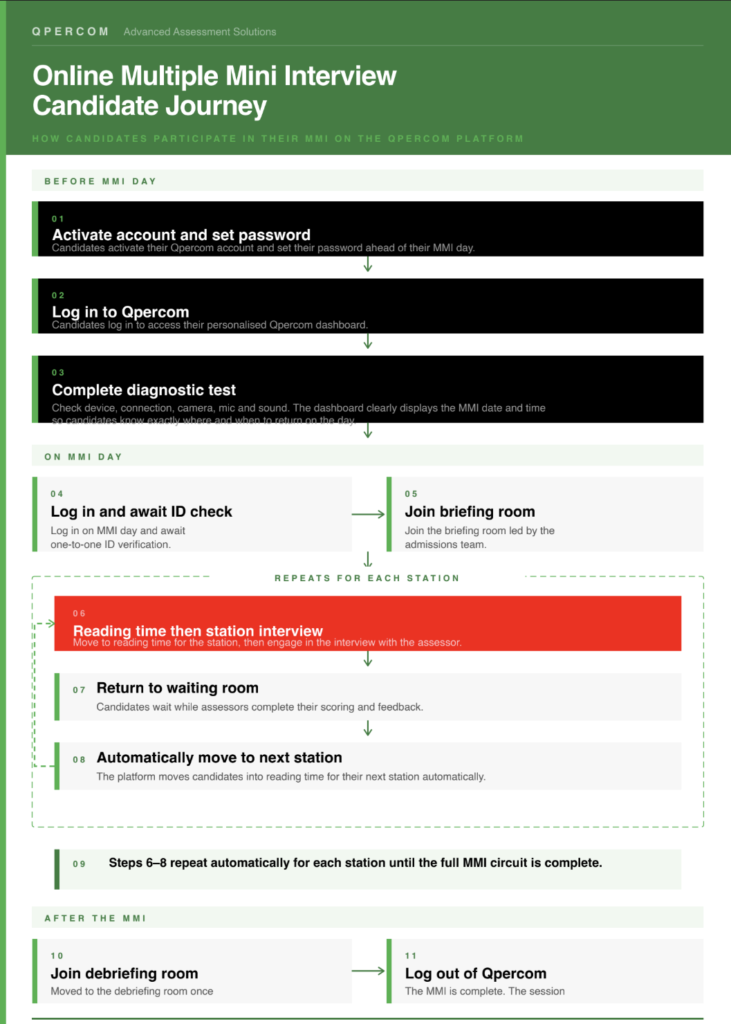
| Every station had to be configured manually as an individual breakout room which is time consuming and laborious. | Qpercom automates the logistics of multi-station assessments meaning there is no manual breakout room management required. Instead, candidates are moved in an automated manner from their waiting room to each reading time and into each of their stations at the press of one button. Ad hoc briefing and debriefing rooms are also used at Ulster University with invitations received on participant screens to join those rooms at the appropriate time. |
| No ‘pre-flight’ checks to highlight possible device, camera, microphone and connectivity issues ahead of taking a MMI on Microsoft Teams. | Candidates complete a self-guided system compatibility check before the interview day to ensure that their device, network connection and browser are all compatible. Compatibility issues which are likely to negatively impact the candidate’s ability to move through the MMI are flagged to both the candidate and the university so they can be provided guidance and/or contacted directly within Qpercom via message or a virtual visit before the start of their interview. |
| Assessors were required to do ID checks for candidates before the first station on each circuit. | On Qpercom, there is a dedicated ID check stage before each MMI circuit begins which facilitates the admissions team to conduct structured ID checks one-to-one with each candidate in their waiting room before each circuit begins. This means there is a full audit trail of which candidates have had their ID checked and assessors at each station can focus on scoring. |
| Instructions on Microsoft Teams can only be viewed when shared by assessors. | On Qpercom, reading instructions can be attached to each scenario and will be automatically shown to candidates during a dedicated Reading Time stage. Candidates also have the ability to access the question at all times if they want to refer back to it during each station. |
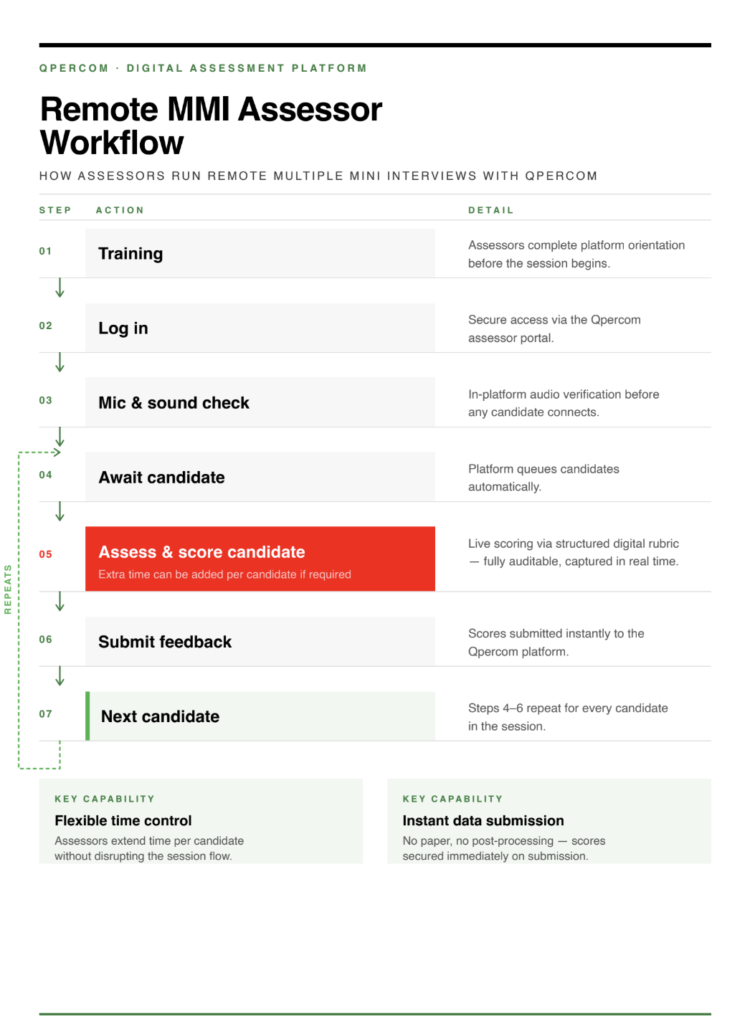
| No standardised timing available for breakout rooms and assessors had to manage timings individually (to ensure all candidates received the full reading and assessment time allowed) as well as scoring and adding feedback comments. | Timings can be pre-set per event on Qpercom and an animated countdown timer is visible at all times on screen for candidates, assessors and administrators. This greatly reduces variation between circuits which is incredibly important for standardisation. The built in ‘extra time’ function allows individual assessors to add extra time if the candidate at their station was disadvantaged e.g short internet dropout or an external distraction outside of their control (e.g. fire alarm). |
| If a candidate dropped out completely and missed all or the majority of a station, the only solution was to keep a record and manually create a breakout room on Microsoft Teams to connect the candidate with the correct assessor to redo the scenario at the end. | Qpercom has an over-rotate function to catch up anyone who missed a station at the end and it happens in an automated manner where the candidate will be returned to the specific station(s) they missed where the correct assessor is waiting for them. |
| Assessors were required to share their screens to show the station instructions, manage their own timings, and score candidates using two devices simultaneously. | Assessors have all information required on one screen with Qpercom so they can see timings, share their screen (if required), report incidents, digitally score and add feedback comments for each candidate. |
| Candidates could see other candidates’ names on the video tiles on Microsoft Teams. | Qpercom facilitates hiding/displaying candidate names as required to better comply with GDPR and only displaying what the admissions team is comfortable with. |
| Assessors were using Microsoft Forms to capture their scores and feedback into which they had to manually type each candidate’s name and number, increasing the potential for human error. | Assessors mark within the same Qpercom platform with each candidate’s name and number pre-populated on the scoresheet to eliminate the risk of incorrectly providing scores and feedback comments to the incorrect candidate. |
| No real-time insight into progress at each station and for each candidate with Microsoft Forms. | Administrators can see in real time whether every candidate has been scored by the correct assessor, effectively eliminating the data integrity risk that comes with manual entry, and assessment data, scores and feedback comments are available to view instantly. |
| A specialist learning technologist had to be on hand every single day of using Microsoft Teams just to keep things running which was a considerable and additional cost. | No specialist learning technologist are required to support on interview days as Qpercom is intuitive for assessment teams to use. |
| When not being assessed, candidates returned to the central meeting room with all other candidates which resulted in a less professional look and feel. | Qpercom allows for a more professional look and feel of interviews with candidates automatically moved from scenario to scenario and when not being assessed are in their own individual room (unless called in for a briefing/debriefing). |

Why Integrity Comes First
For Ulster University, assessment integrity is not a secondary consideration. It is central to the decision to continue delivering their MMIs remotely.
The team introduced second-camera monitoring to allow real-time invigilation of both the candidate and their environment. Their position on this was clear: “We would have considered returning to face-to-face if this feature was not available.”
Their primary concern was ensuring that answers represented each applicant’s own thinking, and that generative AI was not being used during interviews. Second-camera functionality gave them the confidence to continue delivering MMIs remotely without compromising on the standards their rigorous selection process demands.
The Difference It Made
The practical benefits have been clear of Ulster University adopting the Qpercom assessment platform. The specialist learning technologist is no longer needed on interview days. Staffing requirements have reduced across all ten days. The risk of feedback being submitted for the wrong candidate has been effectively removed. Less briefing time is required for assessors and candidates alike. And by automating timing consistently across circuits, the process has become fairer by reducing the variation that, in high-stakes selection, really matters.
As the admissions team put it: Qpercom allows for a more professional look and feel to the interviews.
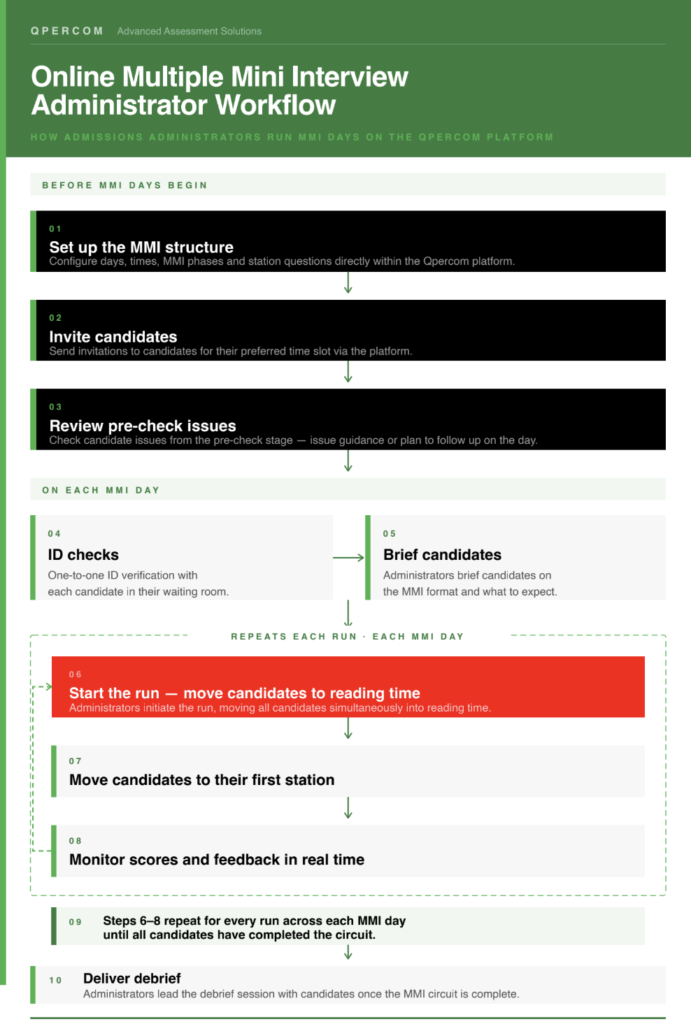
Qpercom Process for Each User Role
Future MMIs and Beyond
As needs evolve at Ulster University, Qpercom continues to develop alongside them. The platform will see the introduction of more advanced proctoring and invigilation tools such as incident flagging and logging, as well as some helpful new features like flexible rest station management, to adapt quickly if a candidate does not attend, ensuring time is managed efficiently on each interview day.
Ulster University’s use of Qpercom extends beyond MMIs. The team also uses the platform for face-to-face Objective Structured Clinical Examinations (OSCE) scoring and feedback, benefiting from the same centralised infrastructure, consistent scoring workflows, competency domain measurement and real-time data capture.
Key Takeaway
Running high-stakes medical selection on general-purpose video conferencing tools is possible. However, it places an unnecessary burden on staff, introduces avoidable risks to data integrity, and makes it harder to deliver the fair, consistent, and defensible process that candidates deserve.
Ulster University’s experience demonstrates what becomes possible when admissions and assessment teams have the right platform behind them, one built specifically for the complexity and responsibility of high-stakes selection.
Qpercom supports healthcare institutions and organisations to deliver remote and hybrid MMIs with confidence by combining centralised administration, automated logistics, real-time oversight, full audit trails and robust assessment integrity in a single platform.