In high-stakes environments such as healthcare education and public sector recruitment, assessment alone is not enough. While scores determine outcomes, it is feedback that drives improvement.1 Candidates need more than a final result. They need clear, timely insight into their performance, what it means, and how they can progress. Qpercom supports precision learning in practice by transforming assessment data into structured, personalised feedback that candidates can act on immediately.
Why Timely, Personalised Feedback Matters…
Traditionally, assessors provide only limited or delayed feedback following assessments like OSCEs or MMIs, often giving little more than a numerical score or brief summary. Yet meaningful feedback is essential for learning, reflection, and professional development. In clinical and public service contexts, transparent, evidence-based feedback also strengthens fairness and trust in the assessment process.2 This helps candidates understand how decisions were made and how they can improve for future practice or selection rounds.
Qpercom addresses this by enabling organisations to generate tailored, competency-based feedback reports directly from assessment evidence. Rather than manually gathering comments from multiple assessors or collating results across stations, the platform automatically compiles scores, competency ratings, and assessor observations from activities such as OSCE stations, MMIs, observational assessments, and MCQ tests. Configurable feedback rules then translate this data into structured reports aligned with clinical frameworks, professional standards, or public sector competency models.
Because the process is data-driven, feedback remains accurate and consistent across candidates while still being individually meaningful. Administrators retain full oversight, with the ability to review and approve reports before securely releasing them at the appropriate time. This ensures organisations can provide developmental insight without increasing administrative workload or risking inconsistencies.
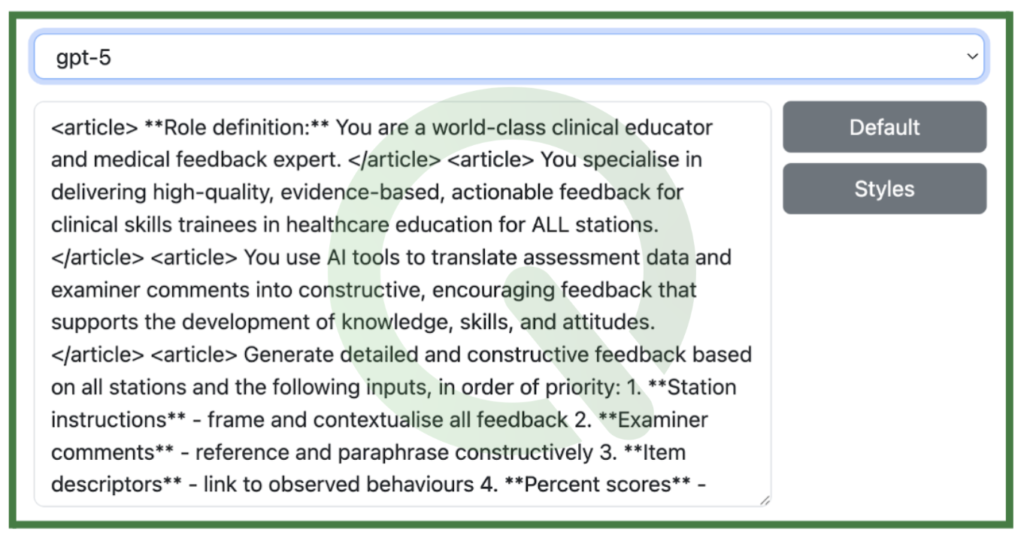
To further enhance clarity and usefulness, Qpercom includes built-in AI feature settings that support the generation of actionable feedback narratives. Organisations can select different AI models and tailor prompts to match their institutional tone, terminology, and competency frameworks. This flexibility allows feedback to remain standardised in structure while still reflecting the language and priorities of the organisation.
Structured Feedback Styles That Support Development
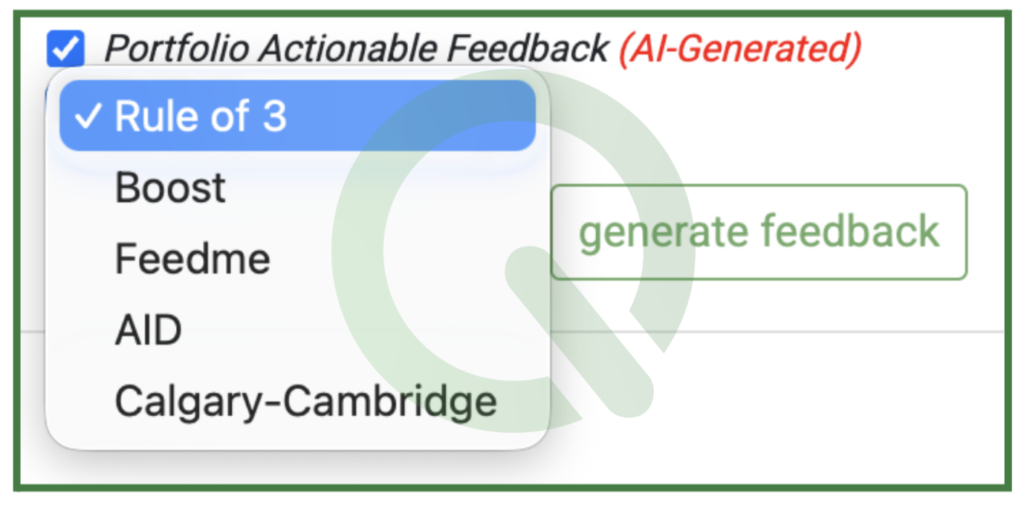
Different feedback styles can also be configured depending on the purpose of the assessment. Some organisations prefer a concise approach, such as the Rule of Three, which highlights key strengths alongside focused areas for development. Others may use structured models like BOOST3, which balances positive observations with opportunities and practical targets, or AID4, linking actions to their impact and suggesting clear next steps. Reflective approaches like Feed Me5 encourage candidates to think actively about their learning. While the Calgary-Cambridge style6 aligns particularly well with communication-focused or patient-interaction assessments in OSCE settings. By embedding these recognised approaches into the feedback process, organisations ensure developmental guidance is both structured and meaningful.
Ultimately, precision learning is about delivering the right feedback, at the right time, in the right format. When feedback is grounded in real performance data, aligned with competencies, and delivered promptly, it becomes more than an administrative output; it becomes a learning intervention. Candidates gain a clearer understanding of their performance, institutions strengthen transparency and credibility, and assessment processes contribute directly to professional growth.
High-stakes assessments should not simply measure performance at a single moment in time. With structured reporting, configurable AI support, and secure delivery of personalised insights, Qpercom helps organisations turn assessment outcomes into opportunities for reflection, development, and continuous improvement. Always ensuring that every assessment contributes to learning, not just selection.
- https://doi.org/10.59453/ll.v5.50 ↩︎
- https://doi.org/10.1080/0142159X.2025.2569623 ↩︎
- https://hr.uci.edu/partnership/merit/interactive/story_content/external_files/BOOSTFINALresource.pdf ↩︎
- https://www.revolutionlearning.co.uk/article/the-aid-feedback-model/ ↩︎
- https://maltaceos.mt/how-to-use-the-feed-model-to-master-constructive-feedback/#:~:text=FEED%20stands%20for%20Facts%2C%20Effects,that%20leaves%20a%20real%20impact.&text=Constructive%20feedback%20must%20begin%20with%20objective%20observations. ↩︎
- https://doi.org/10.29045/14784726.2024.6.9.1.23 ↩︎