
A sound stimulus is conducted to the middle ear in two ways. One of the ways is via the auditory meatus, the tympanic membrane and the middle ear, i.e. the air conduction pathway. The other way is via the skull bones, known as the bone conduction pathway. However, the quality of conduction via the latter is less optimal than conduction via air.
A sound stimulus presented via the skull bones needs to be 20 dB louder than sound presented through the auditory meatus. In other words, 20 dB of sound energy is lost during bone conduction. Once sound reaches the cochlea, it’s processed in an identical manner regardless of the route taken to get there.
Rinne’s tuning fork test is based on this principle. With normal hearing, the tuning fork sound presented via the bone conduction pathway will be inaudible sooner than that presented via the air conduction pathway since 20 dB are lost in the process. With conductive hearing loss in which the loss is greater than 20 dB, a tone presented at the mastoid process will be perceived to be louder than one presented via the air conduction route. The loss of 20 dB in bone conduction is compensated by the loss in air conduction. Within sensorineural hearing loss, the air-conducted tone will be processed as inefficiently as one presented via bone conduction and therefore, the test results will be identical to those for someone with normal hearing.
In Weber’s tuning fork test, the tone is presented to the cochlea through bone conduction. In the case of sensorineural perceptual hearing loss, the affected ear will process the tone to a lesser extent than the healthy ear and therefore the tone will be heard in the healthy ear. This is termed lateralisation to the healthy side. In the case of conductive hearing loss, sound will be registered on the side of the affected ear (lateralisation to the affected side).
There are two causes for this. On the one hand, because of a conduction disorder, the external sound will be diverted away from the cochlea. On the affected side, this will therefore only involve the sound originating from the tuning fork, which has been conducted via the bone. Within the healthy side, this tone competes with all the external sounds. Even when the test is conducted in a completely quiet room, this phenomenon will occur. The second factor that plays a role is that the sound from the tuning fork will escape from the cochlea via the oval window to the outside. Here, it collides with the object causing the conduction disorder and is bounced back to the cochlea. As a result of this, the cochlea of the affected ear will be presented with additional sound. The same phenomenon explains the audiometry findings.
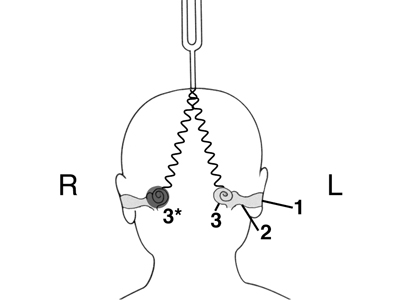
1 = Auditory canal
2 = Middle ear
3 = Cochlea
3* = Affected cochlea
In 3* the vibrating tuning fork is not registered; the sound lateralises to the left.
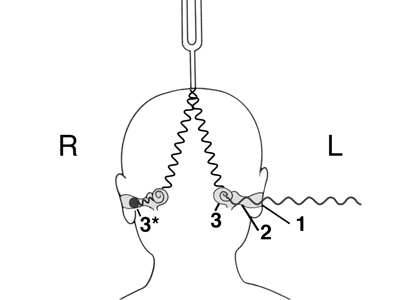
1 = Auditory canal
2 = Middle ear
3 = Cochlea
3* = Disorder of air conduction
The affected air conduction results in hearing loss.
On the left, the background noise reaches the cochlea.
On the right it is blocked by the cause of the reduction in conduction. Sound that reaches the cochlea through bone conduction is reverberated to it by the cause of the affected air conduction, resulting in extra sound reaching the cochlea on the affected side. Hence, the tuning fork is heard louder on the right side.