
Requirements
- Quiet room.
- Audiometer [Figure 12].
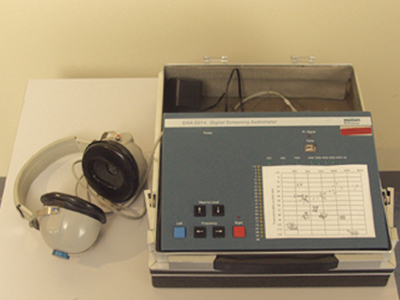 Figure 12
Various different types of audiometers are available. There are simple screening audiometers with which only loss of hearing can be determined in the high, middle and low frequencies. Others are very sophisticated instruments with which both the air and bone conductivity can be measured accurately at different frequencies and sound levels, allowing the nature and extent of the hearing loss to be determined precisely. In many cases, it is also possible to determine the cause of the hearing loss with these instruments.
Procedure
- Inform the patient before starting the examination that you are positioning them so that they cannot see the audiometer or your movements [Figure 19].
- Ask the patient, when they hear a bleep sound, to raise a hand at the side of the ear with which the sound was heard [Figure 20a].
- Start by testing the ear that the patient reports hearing best with.
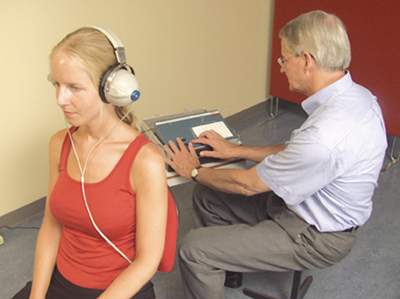 Figure 19
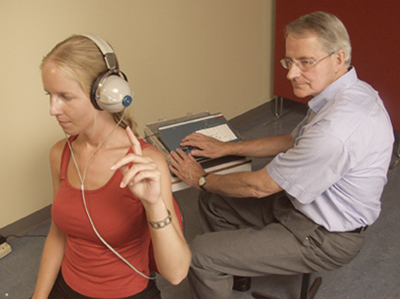 Figure 20a
- Position yourself behind the patient and check that they actually are unable to see the audiometer and your actions.
- Present the patient with a tone with an intensity of 30 dB (this is the threshold value between normal hearing and loss of hearing) and a frequency of 1000 Hz.
- If the patient indicates hearing this tone, reduce the intensity by 10 dB and continue doing so until the patient indicates no longer hearing the tone.
- When this occurs, increase the intensity of the tone again by 5 dB and assess whether the patient can hear the tone.
- If they can hear it, lower the tone by another 5 dB to check whether the lower intensity can be heard after all.
- If the 5 dB increase is not heard either, increase the tone intensity by another 5 dB.
- The lowest tone intensity that can be heard is considered to be the threshold for that tone.
- Once this has been determined for the 1000 Hz frequency, move up to the next frequency and repeat the whole procedure.
- This should be done until the highest measurable frequency on the audiometer has been tested.
- Finally, investigate the frequencies below 1000 Hz.
- If a patient does not indicate hearing a tone presented at 30 dB, increase the intensity by 10 dB, until the patient indicates hearing the tone.
- Subsequently check whether a 5 dB decrease in intensity can be heard.
- The lowest intensity tone that can be heard is considered the threshold for that tone.
- Repeat the test in the same manner for the other ear.
Interpretation Of The Findings
- If the air (and bone) conduction curve shows a hearing threshold of 30 dB or less, the hearing is normal.
- If both the air and bone conduction curve show a threshold of more than 30 dB sensorineural hearing loss is indicated.
- If the threshold is between 30 and 60 dB, the hearing loss is moderate, and if the threshold is greater than 60 dB there is severe hearing loss.
- If only the air conduction curve shows a loss of over 30 dB and the bone conduction curve shows no abnormalities, the patient is suffering from conductive hearing loss.
- Again, between 30 and 60 dB indicates moderate hearing loss and anything above 60 dB represents severe hearing loss.
- A combination of sensorineural and conductive hearing loss is also possible.
- In such cases, air conduction will always be worse than bone conduction.