
Requirements
- 512 Hz tuning fork [Figure 11].
- Quiet room.
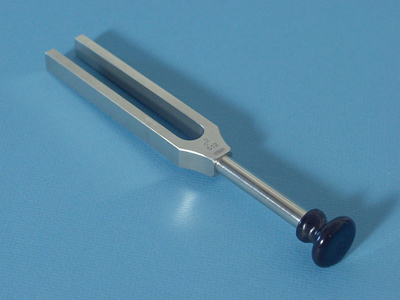 Figure 11
Procedure
- Prior to carrying out the test, tell the patient what they will have to do.
- In this case, they will have to indicate in which ear they hear the humming tone of the tuning fork.
- Sound the tuning fork by striking it firmly against your hypothenar eminence or your thigh.
- You can also use the back of a chair [Figure 13].
- In this case, you will have to muffle the upper tones of the tuning fork by briefly grasping the base of the legs [Figure 14].
- Alternatively, you can firmly squeeze the prongs together [Figure 15] to sound the tuning fork.
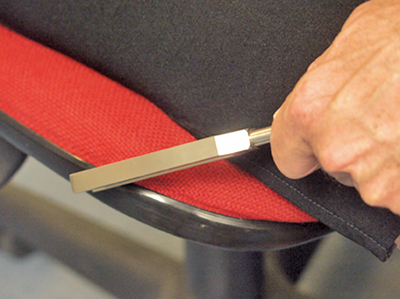 Figure 13
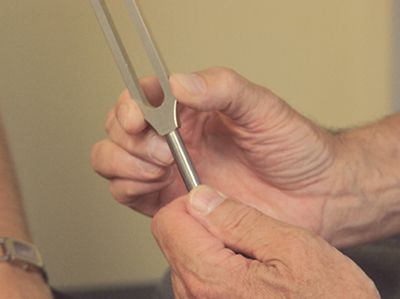 Figure 14
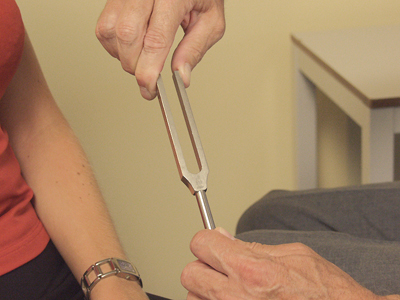 Figure 15
- Press the base of the vibrating tuning fork firmly somewhere on the midline of the patient’s head, so that it is equidistant from each ear.
- This can be the patient’s forehead, just above the nose for example [Figure 16].
- This point is the middle for most people and the contact between the tuning fork and the frontal bone will not be hindered by the presence of hair.
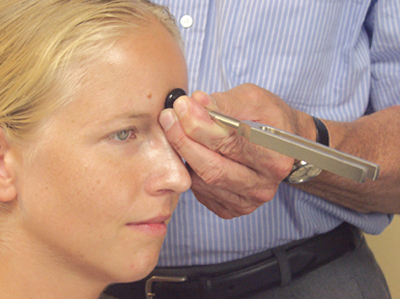 Figure 16
Interpretation Of The Findings
- If the patient can hear the humming tone best in the ear with which they report their hearing to be worst, it indicates conductive hearing loss.
- If the humming tone can be heard best in the ear with which the patient thinks they hear best, it indicates sensorineural hearing loss in the other ear.
- The sound is conducted to the unaffected inner ear.