
Tests to further specify scoliosis
Does the scoliosis disappear when seated?

Procedure
- Allow the patient to sit on a stool with their back towards you.
- Inspect the spine and determine whether the scoliosis, which was present when standing upright, disappears [Figure 46].
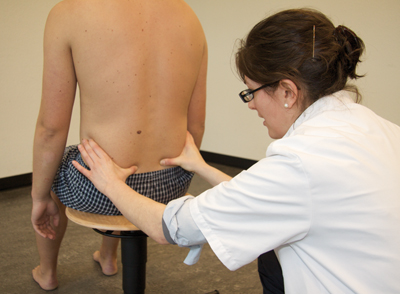 Figure 46
Interpretation
If the scoliosis disappears then it concerns a functional (or non-structural) scoliosis (as found with a difference in leg length).
Conduct, the other scoliosis test if the scoliosis remains present.
Does a gibbus become visible during the anteflexion?
Procedure
- The patient stands with his/her back towards you, and you check (again) whether the pelvis is straight. Any difference in leg length should, prior to this test, be corrected using planks until the pelvis is positioned straight (see Tests when suspecting a difference in leg length).
- Allow the patient to bend over slowly, with the arms hanging and both palms loosely against each other (stoop test). Observe, at eye level, whether both torso halves are moving symmetrically and at the same height [Figure 47].
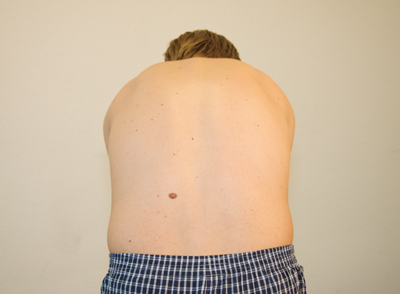 Figure 47
Interpretation
If an asymmetric bulging to the back develops in the rib and/or waist region, then this is called a gibbus.
In such a case determine the localisation and how extensive it is. The presence of a gibbus indicates structural or non-functional scoliosis.
NB. With structural scoliosis, the spinous processes rotate in the direction of the concavity and thereby it seems upon inspection and palpation with the patient standing up, that the scoliosis appears less severe than it is.